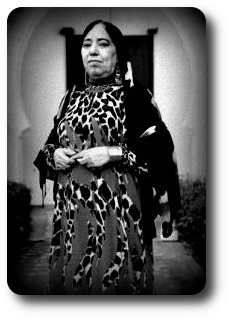
Khadija Bouzoulof, known by her stage name Khadija Atlas, is a famous Moroccan singer and actress, born on January 6, 1975, in Aït Ishaq, a rural village in the province of Khenifra. Dubbed the "Lioness of the Atlas ", she is one of the most iconic figures of Amazigh music in the Middle Atlas.
Her career began in 1992 when she moved from her native village to the city of Khenifra, a musical hub in the Middle Atlas region. She took her first steps in the music industry with Zouhairi Abdelrahim's group and recorded her first song with Moulay Ahmed Al Hassani, a singer and guitarist whose style is characterized by syncopated rhythms, reverberating guitar, and soft vocals. The turning point in her career came after meeting the legendary Mohamed Rouicha, who appreciated Khadija's vocal talent and included her in his group for a series of concerts.
Thanks to her great vocal ability and versatility, the artist became one of the most well-known singers on the Amazigh music scene. She released albums under her own name and in collaboration with various musicians. Among her most successful artistic collaborations was with singer and loutar player Omar Boutmezought, whose songs often addressed social and emotional themes.
In her now thirty-year career, Khadija Atlas has ranged musically across genres, certainly distinguishing herself in Ahidous, but also achieving success in Aita and Chaabi music, performing songs in both Amazigh and Darija, the official language of Morocco.
Since 2018, she has expanded her acting career by appearing in several Amazigh-language television productions. Highly acclaimed for her natural acting ability, Khadija has brought the same energy and authenticity to the small screen that characterizes her musical performances. She recently collaborated with DJ Hamida, a French-Moroccan producer, on "Berbere Holiday" and "La reine du berbère gang," two pop songs in which she provides significant vocals.
Today, Khadija Atlas continues to be a regular presence at major national and international festivals, bringing the culture of the Middle Atlas to the prestigious stages of numerous festivals.
Khadija Bouzoulof, conosciuta con il nome d’arte di Khadija Atlas è una celebre cantante e attrice marocchina, nata il 6 gennaio 1975 a Aït Ishaq, villaggio rurale situato nella provincia di Khénifra. Soprannominata la "Leonessa dell'Atlante", è una delle figure più rappresentative della musica Amazigh del Medio Atlante.
La sua carriera inizia nel 1992 quando dal villaggio natio si trasferisce nella città di Khenifra, centro musicale nevralgico dell’area del Medio Atlante. I primi passi in ambito artistico li muove con il gruppo di Zouhairi Abdelrahim e incide il suo primo brano con Moulay Ahmed Al Hassani, cantante e chitarrista il cui stile è caratterizzato da ritmi sincopati, una chitarra riverberata e un cantato dolce. La svolta decisiva per la sua carriera arriva dopo l’incontro con il leggendario Mohamed Rouicha che apprezza il talento vocale di Khadija e la integra nel suo gruppo per una serie di concerti.
Grazie alle sua grandi capacità vocali e alla sua versatilità, l’artista diviene con il tempo una delle più conosciute cantanti della scena musicale Amazigh. Realizza album a suo nome e in collaborazione con svariati musicisti. Tra le collaborazioni più riuscite a livello artistico vi è quella con il cantante e suonatore di loutar Omar Boutmezought, interprete di brani che affrontano spesso temi sociali ed emotivi.
Nella sua ormai trentennale carriera Khadija Atlas ha spaziato musicalmente tra i generi distinguendosi sicuramente nell’ Ahidous, ma ottenendo buoni riscontri anche nell’Aita e nella musica Chaabi, interpretando brani sia in lingua Amazigh che in Darija, la lingua ufficiale del Marocco.
A partire dal 2018, ha ampliato il suo raggio d'azione dedicandosi alla recitazione in diverse produzioni televisive in lingua Amazigh. Molto apprezzata per la sua naturalezza nel recitare, Khadija ha portato sul piccolo schermo la stessa energia e la stessa autenticità che caratterizzano le sue performance musicali. Recentemente ha collaborato con DJ Hamida, produttore franco marocchino, alla realizzazione di “Berbere Holiday” e "La reine du berbère gang", due brani pop nei quali offre il suo grande contributo vocale.
Oggi Khadija Atlas continua a essere una presenza fissa nei principali festival nazionali e internazionali, portando la cultura del Medio Atlante sui palchi prestigiosi di svariati festival.
Khadija Atlas خديجة أطلس ⵅⴰⴷⵉⵊⴰ ⴰⵟⵍⴰⵙ - Jamilah Records Selection
01 Yach ayma with Mimoune El Khnifri 02 Mayran Imhsaden with Omar Boutmezought 03 Ourak Samakh Aya Ghadhara with Abdelaziz Ahouzar 04 Ntiya Wah Wah 05 Fad galbi hlib with Mohamed Rouicha 06 Ana Ghrib Ana Brani 07 Ouhlagh Ach Ntsbar with Houssa Mon frere 08 Izil izil with Mohamed Rouicha 09 Imourag Ayzig with Abdelaziz Ahouzar 10 Makh makh with Rachid Bahmad 11 Maywalafni Manwalfo 12 Aaz Nas with Mohamed Rouicha 13 Yekh Aghrib 14 Tahidoust with Ahmed Allah Rouicha 15 Kif Nsani 16 Wah ya lahbib with Mohamed Rouicha 17 L3azaziyt Nch Awenna Righ with Moulay Nourdine 18 Chouf arabi 19 Mayran Mayran imourag with Houssa Ahbar 20 Saadi baayouni with Mohamed Rouicha
Mohamed El Hayani was a Moroccan singer, actor, and musician born in Casablanca in 1945 in the Dar El Kartoun neighborhood.
In the late 1950s, his family moved to Derb Bouchentouf, while Mohamed and his brother Mustapha moved to Rabat, to the Agdal neighborhood, where they were raised by their older sister, Fatna. It was she who discovered Mohamed's passion for music and singing, a passion he had manifested since childhood and which led him to drop out of elementary school.
His sister helped him enroll in the National Conservatory of Music and Dance. At the Conservatory, El Hayani was taught by experienced artists such as composer Abdelkader Rachdi, a renowned conductor considered the dean of Moroccan composers.
In 1964, Mohamed Al Hayani joined the national radio choir, distinguishing himself for his talent. There, he was noticed by composer Ali El Haddani, who found in him the perfect performer of his compositions. This encounter would lead to great successes over the years.
Toward the end of the 1960s, encouraged by Abdelkader Rachdi, he recorded his first song, "Ya Oulidi." This was followed by other great songs, including "Yak El Jarh Bra," "Ya Sidi Ana Hurr," "Ana Shuft Ayounak," "Waqtash Tghanni Ya Qalbi," and "Min Dhi Bahak," which would help establish him as a leading artist of the new Moroccan song genre.
Two songs would definitely cement his reputation and success. The first is "Bard wa Skhoun," written by composer Ali El Haddani, which would become one of King Hassan II's favorite songs. The second, entitled "Rahila," features him performing a sublimely poetic composition by the great Abdul Salam Amer.
A refined artist, Mohamed al Hayani stood out for his composure, character, and elegant performance, all factors that contributed to him being called "The Nightingale of Morocco," a term coined by another great nightingale, Abdel Halim Hafez.
In 1982, he participated in the film "Doumoue Nadam," by Moroccan director Hassan El Moufti, starring alongside Hamadi Amor and Habiba Madkouri.
Frustrated by the Moroccan music scene of the 1980s, Mohamed al Hayni considered retiring from the stage, but encouraged by his family, he continued his artistic career, releasing new, high-quality songs, including "Dunya," "Enta Liya wa Ana Lik," "Mustahil," and "Eliza."
He died on October 24, 1996, at the age of 50. With his passing, society lost a national treasure, one of the pioneers of modern Moroccan music.
Mohamed El Hayani è stato un cantante, attore e musicista marocchino nato a Casablanca nel quartiere di Dar El Kartoun nel 1945.
Alla fine degli anni '50, la sua famiglia si trasferisce a Derb Bouchentouf
mentre Mohamed e suo fratello Mustapha si trasferiscono a Rabat, nel quartiere di Agdal, dove saranno cresciuti da Fatna, la sorella maggiore. Sarà lei a scoprire la passione di Mohamed per la musica e il canto, una passione che egli manifesta fin dall'infanzia e che lo porta lasciare la scuola elementare.
La sorella lo aiuta a iscriversi al Conservatorio Nazionale di Musica e Danza. Al Conservatorio, El Hayani viene istruito da artisti esperti come il compositore Abdelkader Rachdi, direttore d’orchestra molto rinomato, considerato il decano dei compositori marocchini.
Nel 1964 Mohamed Al Hayani si unisce al coro della radio nazionale distinguendosi per il suo talento. In quella sede viene notato dal compositore Ali El Haddani che in lui trova il perfetto esecutore delle sue composizioni. Da questo incontro nasceranno nel corso degli anni grandi successi.
Verso la fine degli anni 60, incoraggiato da Abdelkader Rachdi, incide la sua prima canzone intitolata "Ya Oulidi" a questa seguiranno altri grandi brani tra i quali "Yak El Jarh Bra", "Ya Sidi Ana Hurr", "Ana Shuft Ayounak", "Waqtash Tghanni Ya Qalbi" e "Min Dhi Bahak" che contribuiranno ad affermarlo come artista di punta della nuova canzone marocchina.
Due brani consacreranno decisamente la sua reputazione.e il suo successo. Il primo è "Bard wa Skhoun" frutto della penna del compositore Ali El Haddani, che diverrà una delle canzoni preferite di Re Hassan II mentre il secondo, intitolato “ Rahila”, lo vede interpretare una composizione di sublime poesia del grande Abdul Salam Amer.
Artista raffinato, Mohamed al Hayani si è distinto per la sua compostezza, il carattere e l’ eleganza nell’esecuzione, tutti fattori che hanno contribuito a definirlo “L’usignolo del Marocco”, termine permutato dall’altro grande usignolo Abdel Halim Hafez.
Nel 1982 partecipa alla realizzazione del film "Doumoue Nadam",
del regista marocchino Hassan El Moufti, recitando al fianco di
Hamadi Amor e Habiba Madkouri .
Frustrato dalla scena musicale
marocchina degli anni ‘80, Mohamed al Hayni pensa al ritiro dalle
scene, ma incoraggiato dalla famiglia prosegue l‘attività
artistica realizzando nuovi brani di buon valore tra i quali
"Dunya", "Enta Liya wa Ana Lik", "Mustahil"
ed "Eliza".
Morirà il 24
ottobre 1996 all'età di 50 anni. Con il suo decesso la società
perde un tesoro nazionale, uno dei pionieri della musica moderna
marocchina.
Mohamed El Hayani محمد الحياني - Mtayeb Allah مثايب الله
Side A Mtayeb Allah Part 1 مثايب الله Side B Mtayeb Allah Part 2 مثايب الله
The Ghiwaniyya, that cultural renewal born at the beginning of the 70s in Morocco by musical groups such as Nass el Ghiwane, Jill Jilala and Lemchaheb, spread like wildfire throughout the country and meant that various musical groups would come to life.
Kenitra, a city overlooking the Atlantic Ocean in the north of the country, also gave its contribution to the revival of popular singing with the musical group called Lemkhaleb. Very little is known about them. It seems they were formed in the second half of the seventies and were led by banjo player Hassan Haddush. Both in their musical approach and in their organization they followed in the footsteps of Nass el Ghiwane, the founder group of the movement and the guiding light of the Kenitra group's musical production.
Very little information can be found on their Facebook page which documents the group's return to activity (with different formation). In circulation there is only one CD made in recent years and the album created by the Sawt-Hilali record company for its sub-label Hillali Disques.Both works, not easy to find, offer a nice insight into the art of this forgotten Moroccan group which perhaps would have deserved more visibility.
La Ghiwaniyya , quel rinnovamento culturale nato all’inizio degli anni ‘70 in Maroccco ad opera di gruppi musicali quali Nass el Ghiwane, Jill Jilala e Lemchaheb si è diffuso a macchia d’olio in tutto il paese e ha fatto si che vari gruppi musicali prendessero vita .
Anche Kenitra, città affacciata sull’oceano atlantico nel nord del paese, ha dato il suo contributo alla rinascita del canto popolare con il gruppo musicale chiamato Lemkhaleb.
Di loro si sa davvero poco. Pare si siano formati nella seconda metà degli anni settanta e che fossero guidati dal suonatore di Banjo Hassan Haddush . Sia nell’approccio musicale che nell’organigramma ricalcavano le orme di Nass el Ghiwane, gruppo capostipite del movimento e faro guida della produzione musicale del gruppo di Kenitra.
Pochissime notizie si posso trovare sulla loro pagina Facebook che documenta il ritorno in attività del gruppo (con diversa formazione).
In circolazione si trovano solo un cd realizzato in anni recenti e l’album realizzato dalla casa discografica Sawt-Hilali per la sua sotto etichetta Hillali Disques. Entrambi i lavori, non di facile reperibilità, offrono un bello spaccato dell'arte di questo dimenticato gruppo marocchino che forse avrebbe meritato più visibilità.
Lemkhaleb لمخالب - Groupes Marocains Modernes
Sawt-Hilali – NSH 33134
A1 Ayami هيامي A2 M'Hayni محايني B1 El Guelsa الجلسة B2 Ya Lah Maya ياله معيا B3 Salou Alina
Latifa Al Idrisi, known by the stage name of Latifa Amal, was a Moroccan singer born in Safi in 1935. Born essentially as an interpreter of songs belonging to the musical tradition of the Aita of the high atlas, she demonstrated, already as a child, a natural aptitude for singing and dancing.
Her interpretative qualities were first noticed during a gala evening held at the royal palace on the occasion of King Hassan II's birthday. The radio host, who introduced the singers participating in the event, will advise her to consider starting a solo career. She will collaborate with the famous musician Bouchaib El Bidaoui, one of the leading exponents of the renewal and conservation of the Aita genre in Moroccan society of the 1950s.
Like other singers similar to her (Al Hajja Al Hamdaouia in primis), she will be supported by the Algerian singer Salim Hilali, who with his famous club "Le Coq d'Or", opened in 1949 in the medina of Casablanca, will provide the opportunity for young musicians to be noticed by the general public.
She will achieve great visibility following the creation of various successful singles and her performances, both at home and abroad, will always receive great acclaim. Worthy of note are her participation in the Marrakech festival and the concerts held at the Olympia in Paris.
During her career she will often try her hand at modern song but deep down she will always remain a great interpreter of the Aita, a genre for which she will be much loved.
Her career, which began around the mid-1950s, will end on August 16, 1986 (some sources report December 1990) when she perishes following a terminal illness.
Unfortunately, she will not be able to benefit from the recovery and enhancement of the artistic tradition of the country initiated by Mohammed VI in the early 2000s and her figure will therefore remain somewhat on the sidelines.
However, her songs remain to remind us how much this brilliant Moroccan singer knew how to touch and inflame the hearts of her audience.
Latifa Al Idrisi, conosciuta con il nome d’arte di Latifa Amal, è stata una cantante marocchina nata a Safi nel 1935. Nata essenzialmente come interprete di canzoni appartenenti alla tradizione musicale dell’Aita dell’ alto atlante ha dimostrato, già da bambina, un attitudine naturale al canto ed al ballo.
Le sue qualità interpretative furono notate per la prima volta nel corso di di una serata di gala tenutasi al palazzo reale in occasione del compleanno di re Hassan II. Il conduttore radiofonico,che presentava i cantanti partecipanti all’evento, le consiglierà di prendere in considerazione l’avvio di una carriera solista.
Collaborerà con il famoso musicista Bouchaib El Bidaoui, uno dei massimi esponenti del rinnovamento e della conservazione del genere Aita nella società marocchina degli anni ‘50.
Al pari di altre cantanti a lei simili (Al Hajja Al Hamdaouia in primis), sarà sostenuta dal cantante algerino Salim Hilali , che con il suo famoso locale “Le Coq d'Or”, aperto nel 1949 nella medina di Casablanca, fornirà l’occasione ai giovani musicisti di essere notati dal grande pubblico.
Conseguirà una grande visibilità in seguito alla realizzazione di vari singoli di successo e le sue esibizioni, sia in patria che all’estero, otterranno sempre grande plauso. Degne di nota sono la sua partecipazione al festival di Marrakech ed i concerti tenuti all’Olympia di Parigi.
Nel corso della sua carriera si cimenterà spesso con la canzone moderna ma nel profondo rimarrà sempre un grande interprete dell’Aita, genere per il quale sarà molto amata.
La sua carriera, cominciata intorno alla metà degli anni ’50, si interromperà il 16 agosto 1986 (alcune fonti riportano il Dicembre del 1990) quando perirà in seguito ad una malattia terminale.
Purtroppo non potrà beneficiare dal recupero e dalla valorizzazione della tradizione artistica del paese avviate da Mohammed VI agli inizi del 2000 e la sua figura rimarrà quindi un po' in disparte.
Restano tuttavia le due canzoni a ricordarci quanto questa brillante cantante marocchina sapesse toccare ed infiammare il il cuore del suo pubblico
Latifa Amal لطيفة أمال Collection
01 Laghrayeb الغرايب 02 Khuya zurny خويا زورني 03 Mal Habibi مال حبيبي 04 Sir Ma'a Badad سير مع بضاض 05 Al'ar ya al 'ar العار يا العار Pt.1 06 Al'ar ya al 'ar العار يا العار Pt. 2 07 Mawaly baghdad مولى بغداد 08 Yak A labass ياك أ لاباس 09 Mawwal al barraka مول البراكة 10 Saddu sharajamakum سدّو شراجمكم 11 'alash qata'at kalamy علاش قطعت كلامي 12 Manich Mana منيش منا 13 Rani Mhayarvراني محير 14 Ma shuftu Lghazal ما شفتو لغزال 15 Ya al kawiny binaru يا الكاوني بنارو 16 Ya al'ashqin saliu al madany يا عاشقين صليوا على المدني Pt. 1 17 Ya al'ashqin saliu al madany يا عاشقين صليوا على المدني Pt. 2 18 Al Zaouia الزاوية 19 Qassida Al Bahi قصيدة الباهي 20 Hal halal soum هل هلال الصوم 21 Dhanby 'alayk al habiby ذنبي عليك الحبيب Pt 1 22 Dhanby 'alayk al habiby ذنبي عليك الحبيب Pt 2 23 El 'assasa العساسة Pt 1 24 El 'assasa العساسة Pt 2 25 Ilahi الهي 26 Herraz Hakim min al hajaz حراز حكيم من الحجاز
Second release regarding that almost forgotten music from a truly creative era of Moroccan cultural history. A new handful of fantastic 7 "made by equally fantastic bands. Many of them have never made a proper album and only in recent years some compositions have appeared on commemorative CDs and cassettes. What remains of their work can only be found on some 7 "still in circulation in the collectors market, often at very high prices.
Seconda uscita per quanto riguarda quella musica quasi dimenticata proveniente da un epoca veramente creativa della storia culturale marocchina . Una nuova manciata di 7" fantastici realizzati da gruppi altrettanto fantastici. Molti di loro non hanno mai realizzato un vero e proprio album e solo negli ultimi anni alcune composizioni sono apparse su cd e cassette commemorativi . Cio che rimane della loro opera è rintracciabile solo su alcuni 7" ancora in circolazione nel mercato del collezionismo, spesso a prezzi molto elevati.
Hadda Ouakki was born in 1953 in Ait Ishaq, a village of humble shepherds located in the hills of the Middle Atlas in Morocco's Khenifra province. She belonged to a family that included among its members exponents of the local religious community, she found herself having many problems, in the domestic sphere, due to her independent character. Attracted by the rhythms of Amazigh music from a very young age, the young Hadda at the age of 4, sneaked out of her father's house to attend the popular nocturnal festivals during which Berber women brought their poetry to the square using songs and dances.
Growing up in an era in which Moroccan society saw women as the fundamental pillar of tradition and of the family, she was denied the possibility of accessing studies, thus forcing her to illiterate. A child with a lively mind, Hadda carefully observed the surrounding reality, drawing great lessons from it. She later recalled: "I never went to school, I learned everything by listening, imitating and memorizing".
At the age of 8 she will have some traditional symbols of the Amazigh culture tattooed on her face as a sign of belonging. As a member of a Marabutti family, such a gesture (like singing and public performance) was inadmissible, as well as forbidden.
The mother's fury will be immense, she will leave her out of the house for a while before calming down.
The rebellious spirit of what would become the queen of Amazigh song thus manifested itself precociously. In Morocco in the 1950s, in full urbanization, musicians and singers began to have a bad reputation. Public performance was considered by many to be the same as prostitution and music was often associated with sex, alcohol and licentious behavior in general. If for a man the climate was not entirely rosy, for a member of the female gender it was something really unthinkable.
Faced with Hadda's continuing passion for music, with the intent of averting dishonor and keeping family respectability intact, her parents forced her, at the age of 14, to take an elderly but respectable man of seventy years as a husband. Fortunately, the marriage lasted only fifteen days. Hadda herself went to a judge to present her case and obtained an annulment by virtue of the invalidity of the marriage due to her young age.
This made the girl aware of her fate. If she wanted to make the music her life she would have to emancipate herself and leave her family. Hadda Ouakki, putting in place an unprecedented act of rebellion against the society to which she belongs, will never marry again and will never have children. Music will become her only reason for her life and she will never regret this choice.
The opportunity for a turning point came in 1968. During a village festival, music teacher Bennàsser Oukhouya listened to Hadda sing and was very impressed by her vocal abilities. This fact will start a splendid adventure. The young Berber at 16 will flee to Casablanca with the one who will become her mentor and lyricist for the next 12 years. The partnership of what will be called "the eternal duo", a collaboration that will deeply mark the history of the Amazigh song of the Middle Atlas, will end in 1981 when Hadda will give life to a group of her own
Life in Casablanca will mark one of the most brilliant moments in the career of the Berber singer who, evoking the recording sessions and evening shows in the company of Bennàsser and the accompanying group of singers in hotels and clubs, will say: "Of that period I only good memories ".
Gifted with a powerful and versatile voice, she soon fed the jealousy of her colleagues, intimidated by her talent. Very often, in her early days, she was prevented from singing and she was put aside by her. One particular evening he managed to perform to the best of her potential and she stunned the manager of the club who said ecstatically: "This is the new Umm Kulthum" (Egyptian Umm Kulthum is considered the greatest Arab singer ever).
Since then, her career will be unstoppable and her voice will soon be known throughout Morocco. An important factor for the development and consolidation of the artist's career will be represented by the economic expansion of Casablanca during the 1970s. Large masses of peasants left their lands to move to the city and in Hadda and Bennasser's songs they found something familiar, a reminder of what they had, a way to keep in touch with their roots. The musical repertoire proposed by this magnificent duo descends from an ancient oral tradition that reflects the daily life and aspirations of the Moroccan population belonging to the working classes. The themes addressed by the lyrics of their songs, powerful, provocative, humorous and imbued with an ancient poem, concern social issues, religion, daily chores, personal aspirations and obviously love, both romantic and sensual, well represented by the song “Al 'alam al' alam” which, in the opinion of the Moroccan anthropologist Lahsen Hira, represents a “genuine praise to carnal love thrown in the face of the Puritans”.
Straightforwardness and expressive power, which have made her a darling of the popular classes, will not fade when in 1981 Hadda Ouakki artistically separated from her historical mentor. From that moment, until the mid-90s, she will be the first and only Moroccan woman to lead a musical group and she will become a true legend of the musical genre called 'aïta Zaâria. Equipped with a powerful and versatile voice capable of passing from a very low register to a very high one within a single verse, Hadda Ouakki excels in the art of Timawayin (plural Tamawayt) a particular form of poetry, typical of the Amazigh culture of the Middle Atlas, based on improvisation. Considered a journey into the soul of the Amazigh culture that expresses a particular vision of existence and life, the Timawayn can be defined as the "sound timbre" of the Middle Atlas, an individual vocal exercise inaccessible to common singers of which Hadda Ouakki proved an excellent interpreter.
A true manifesto of freedom Hadda Ouakki will continue to reap successes consolidating and increasing her fame even outside the borders of Morocco. The partnerships with new musicians and lyricists will also continue;
Wonderful will be her collaboration with Abdellah Zahraoui, with whom she will maintain an artistic partnership that will last for 40 years and will record several albums including the excellent "Ayn Zora", will be equally fruitful the collaborations with the singer and player of Loutar Mghani Muhammed, specialized in the traditional song of the Zayanes people living in the Khenifra region, and with Sheikh Hamid.
In 2015 the French director Jacqueline Caux will make a documentary to pay the right homage to the life of this great artist (and great woman) of the Middle Atlas. The short film, entitled "Hadda Ouakki - Chant d’une Rebelle", in addition to remembering Hadda's life, provides an opportunity to explore Casablanaca's past during the period of its profound urban transformation. Currently Hadda Ouakki continues to live with her music and to carry on her human as well as artistic discourse. Always rebellious and proud, this Berber woman of the Middle Atlas has profoundly marked the history of the Amazigh song and has represented, and continues to represent, a model for all those women who intend to free themselves from the patriarchal logic that govern not only Moroccan reality, but society contemporaries in general.
Hadda Ouakki è nata nel 1953 a Ait Ishaq, un villaggio di umili pastori situato sulle colline del Medio Atlante nella provincia di Khenifra in Marocco. Appartenente ad una famiglia che annoverava tra i suoi membri esponenti della comunità religiosa locale, si trovò ad avere non pochi problemi , in ambito domestico, a causa del suo carattere indipendente.
Attratta dalle ritmiche della musica Amazigh sin da piccolissima , la giovane Hadda all'età di 4 anni, scivolava furtiva fuori dalla casa paterna per assistere alle feste popolari notturne nel corso delle quali le donne berbere portavano la loro poesia in piazza utilizzando canti e danze.
Cresciuta in un epoca in cui la società marocchina vedeva la donna come il pilastro fondamentale della tradizione e della famiglia, le fu negata la possibilità di accedere agli studi, costringendola cosi all'analfabetismo. Bambina dalla mente vivace, Hadda osservò attentamente la realta circostante traendone grande insegnamento.
Ricorderà in seguito : " Non sono mai andata a scuola, ho appreso ogni cosa ascoltando, imitando e imparando a memoria".
All'età di 8 anni si farà tatuare sul viso alcuni simboli tradizionali della cultura amazigh come segno di appartenenza. In quanto menbro di una famiglia di Marabutti, un gesto simile ( al pari del canto e dell'esibizione pubblica ) era inammissibile, nonchè proibito .La furia della madre sarà immensa, la lascerà fuori casa per un certo periodo prima di rabbonirsi.
Lo spirito ribelle di quella che sarebbe divenuta la regina del canto Amazigh si manifestò quindi precocemente.
Nel Marocco degli anni 50, in piena urbanizzazione, i musicisti ed i cantanti cominciarono ad avere un cattiva reputazione. L'esibizione in pubblico era da molti considerata alla stregua del meretricio e la musica veniva spesso associata a sesso, alcool e a comportamenti licenziosi in generale. Se già per un uomo il clima non era del tutto roseo, per un appartenente al genere femminile si trattava di qualcosa di veramente improponibile.
A fronte della continua passione di Hadda per la musica, con l'intento di scongiurare il disonore e mantenere intatta la rispettabilità familiare, i genitori la costrinsero, all'età di 14 anni, a prendere per marito un anziano,ma rispettabile, signore di settanta anni.
Il matrimonio durò fortunatamente soltanto quindici giorni. Hadda stessa si recò da un giudice per esporre il proprio caso ed ottenne l’annullamento in virtù della non validità dello sposalizio a causa della sua giovane età.
Il fatto rese la ragazza consapevole del proprio destino. Se avesse voluto fare della musica la sua vita avrebbe dovuto emanciparsi e abbandonare la famiglia.
Hadda Ouakki , mettendo in atto un inaudito atto di ribellione verso la società di appartenenza non si sposerà mai più e non avrà mai figli. La musica diverrà la sua unica ragione di vita e mai si pentirà di questa scelta.
L'occasione per una svolta avvenne nel 1968. Nel corso di una festa di paese, il maestro di musica Bennàsser Oukhouya ascoltò Hadda cantare e rimase molto colpito dalle sue capacità vocali. Questo fatto darà inizio ad un splendida avventura. La giovane berbera a 16 anni fuggirà a Casablanca con colui che diverrà il suo mentore e paroliere per i 12 anni che seguiranno. Il sodalizio di quello che sarà chiamato “l'eternel duo “,una collaborazione che segnerà profondamente la storia della canzone Amazigh del Medio Atlante, finirà nel 1981 quando Hadda darà vita ad un gruppo tutto suo.
La vita a Casablanca segnerà uno dei momenti più brillanti della carriera della cantante berbera la quale, evocando le sessioni di registrazione e gli spettacoli serali in compagnia di Bennàsser e del gruppo di cantanti di accompagnamento in alberghi e locali, dirà : "Di quel periodo ho solo bei ricordi".
Dotata di una voce potente e versatile alimentò presto la gelosia delle colleghe, intimorite dal suo talento. Molto spesso, nei primi tempi, le veniva impedito di cantare e veniva messa da parte. Una particolare sera riusci ad esibirsi al meglio delle sue potenzialità e lascio di stucco il direttore del locale che affermò estasiato : "Questa è la nuova Umm Kulthum " (L'egiziana Umm Kulthum è considerata la più grande cantante araba di sempre).
Da allora la sua carriera sarà inarrestabile e la sua voce sarà conosciuta in breve tempo in tutto il Marocco.
Un fattore importante per lo sviluppo ed il consolidamento della carriera dell'artista sarà rappresentato dall'espansione economica di Casablanca avvenuta nel corso degli anni '70.
Grandi masse di contadini abbandonarono le loro terre per trasferirsi in città e nelle canzoni di Hadda e Bennasser trovarono un qualcosa di familiare, un ricordo di ciò che avevano, un modo per restare in contatto con le proprie radici .
Il repertorio musicale proposto da questo magnifico duo discende da un antica tradizione orale che riflette la vita quotidiana e le aspirazioni della popolazione marocchina appartenere alle classi lavoratrici. I temi affrontati da i testi dei loro brani , potenti, provocatori , umoristici e intrisi di un antica poesia, interessano le questioni sociali, la religione, le incombenze quotidiane , le aspirazioni personali ed ovviamente l'amore, sia romantico che sensuale, ben rappresentato dal brano “Al 'alam al 'alam” il quale , secondo l'opinione dell'antropologo marocchino Lahsen Hira , rappresenta una “genuina lode all'amore carnale gettata in faccia dei puritani”. Schiettezza e potenza espressiva,che hanno fatto di lei una beniamina delle classi popolari, non scemeranno quando nel 1981 Hadda Ouakki si separerà artisticamente dal suo storico mentore. Da quel momento, sino alla metà degli anni '90, sarà la prima ed unica donna marocchina alla guida di un gruppo musicale e diverrà una vera e propria leggenda del genere musicale chiamato ‘aïta Zaâria .
Dotata di una voce possente e versatile capace di passare da un registro bassissimo ad uno molto elevato all'interno di un unica strofa , Hadda Ouakki eccelle nell'arte del Timawayin (al plurale Tamawayt ) una particolare forma di poesia, propria della cultura amazigh del Medio Atlante, basato sull'improvvisazione.
Considerato un viaggio nell'anima della cultura Amazigh che esprime una particolare visione dell'esistenza e della vita, il Timawayn può essere definito il "timbro sonoro" del Medio Atlante, un esercizio vocale individuale inaccessibile ai cantanti comuni del quale Hadda Ouakki si è dimostrata un interprete eccellente.
Vero e proprio manifesto di libertà Hadda Ouakki continuerà a mietere successi consolidando e accrecendo la sua fama anche al di fuori dei confini del Marocco. Continueranno anche I sodalizi con nuovi musicisti e parolieri ; Storica sarà la collaborazione con Abdellah Zahraoui, con il quale manterrà un sodalizio artistico che si protrarrà per 40 anni e registrerà svariati album tra I quali l’ottimo “ Ayn Zora”, mentre altrettanto fruttuose saranno le collaborazioni con il cantante e suonatore di Loutar Mghani Muhammed, specializzato nella canzone tradizionale del popolo Zayanes abitante la regione di Khenifra, e con Sheikh Hamid.
Nel 2015 la regista francese Jacqueline Caux realizzerà un documentario per tributare il giusto omaggio alla vita di questa grande artista ( e grande donna ) del Medio Atlante. Il cortometraggio, intitolato “ Hadda Ouakki - Chant d’une Rebelle”, oltre a ricordare la vita di Hadda fornisce l’occasione per esplorare il passato di Casablanaca durante il periodo della sua profonda trasformazione urbana.
Attualmente Hadda Ouakki continua a vivere di musica e a portare avanti il suo discorso umano oltre che artistico. Sempre ribelle e fiera questa donna berbera del Medio Atlante ha segnato profondamente la storia della canzone Amazigh e ha rappresentato , e continua a rappresentare, un modello per tutte quelle donne che intendono affrancarsi dalle logiche patriarcali che governano non solo la realtà marocchina, ma le società contemporanee in generale.
Bennacer Ou Khouya بناصر أوخويا - Folklore du Moyen Atlas
A1 Rah Additou راة الديتو A2 Douar Ezzine دوار الزين A3 Laasrya العصرية B1 Laghrib الغريب B2 Howa Malou هو مالو B3 Ahya Mali اهيا مالي
01 Salba salba سالبة سالبة 02 Mani Ghaynekh Ida Yourelli أما غر غا كنخ إيضا كوريلي 03 Enkhach Ouri Ghouri Ma Chibdan أوا نيخاش أورا غوري 04Awra ayawra اورا ايا ورا 05 Ana mourak ana koudamak انا مراك انا قدامك 06 Khalitiha fi qalbi خلتيها في قليبي 07 Al 'alam ya al 'alam العالم يا العالم 08 Al layal ya al layla الليل يا الليل 09 wash ja idir وَاشْ جَا إيْدِيْر 10 Ayura Ayura ايورا ايورا 11 Ana Kindir اناكندير 12 wa'tiqni al fkih واعتقني ألفقيه 13 Awaji nqul lik al gharaib mada أواجي نقول ليك الغرايب مادا 14 Walinnar sha'ala والنار شاعلة 15 Ahia al mima اهيا الميمة
01 Hadha wa kana هذا وكان 02 Al Barakiyya البركية 03 Al Misriyya المصرية 04 Al Gharib الغريب 05 Al Walf الولف 06 Qalbi ma hunani قلبي ما هناني 07 Hawal ta'dy حاول تعدي 08 Amran fawsa امرا فوس 09 Iouarou إيواروا 10 Literhalt لترحلت 11 Koun Ma Lahssad كن ما لحسد 12 Rabia ربيعة 13 Ma laha kanat jaya ما لها كانت جايا 14 Al ghiram ma 'inda du الغرام ما عنده دوا 15 Mawlan 'ain al tawt مولا عين التوت 16 Al kanawy الكناوي 17 Namshi 'amaa bidad part 1 نمشي عما بضاض 18 Namshi 'amaa bidad part 2 نمشي عما بضاض 19 Sarak Adak سرك هاداك 20 Firak Habibi فراق حبيبي
Benasser Oukhouya , Hadda Ouakki & Khaduja al Zamurriya بناصر أوخويا و حادة أوعكي و خدوج الزمورية
A1 Waras Idad aw haraz وراس اضاض اوحراز A2 Idda aw Habibi ادا اوحبيب B1 Aw ryad al shahqilukh walo اورياد الشحقيلخ والو B2 Aw ritghint ista اورتغينت استا
Hadda Ouakki حادة أوعكي - Fin huwa fin huwa فين هو فين هو
01 Fin huwa fin huwa فين هو فين هو. 02 Mashi akhsara fik ماشي اخسارة فيك 03 qalbi makad yasbar قلبي ماكاد يصبر 04 Ya al Gharib aw ya al barany يا الغريب اويا البراني