Visualizzazione post con etichetta RAI. Mostra tutti i post

lunedì 30 maggio 2022

Boutaiba Sghir بوطيبة الصغير Issue # 2


About a couple of years ago I published a post dedicated to the great Algerian musician Boutaiba Sghir, considered the father of the modern Rai. Recently I have come into possession of further recordings belonging to the repertoire of the musician in question.  

These are a couple of cassettes recorded in France during the eighties and the material made available by Alex Poe, creator of The Musical Goldilocks Zone, a blog born in April this year.

  It is very good stuff, qualitatively acceptable, which allows us to deepen our knowledge of the work of Boutaiba Sghir. 

 I sincerely thank Alex and invite you to visit his nice blog.


Circa un paio di anni or sono ho pubblicato un post dedicato al grande musicista algerino Boutaiba Sghir, considerato il padre del moderno Rai. Recentemente sono entrato in possesso ulteriori registrazioni appartenenti al repertorio del musicista in questione . Si trattadi un paio di cassette registrate in Francia nel corso degli anni ottanta e del materiale messo a disposizione da
Alex Poe, artefice del blog
The Musical Goldilocks Zone nato nell'aprile di quest'anno.

Si tratta di roba buonissima, qualitativamente accettabile, che ci permette di approfondire la conoscenza dell'opera di Boutaiba Sghir.

Ringrazio Alex di cuore e vi invito a visitare il suo bel blog.


Boutaiba Sghir MCPE 1389


Label : MCPE 1389

Format : Tape

A1 Hak Ouaadi  
A2 Chehal Hadrou 
A3 Ma Diriche Aalia
B1 Ya Chaki 
B2 Diri Laakel
B3 Khalini Mezine 

HERE


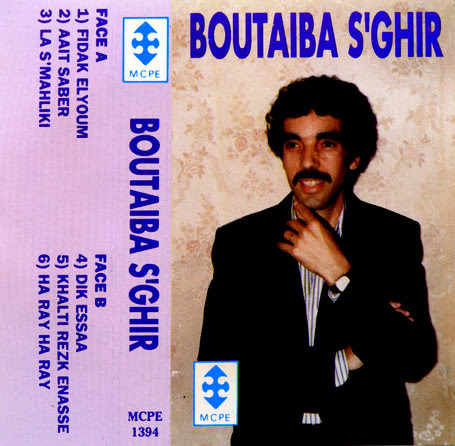
Boutaiba Sghir  MCPE 1394


Label : MCPE 1394

Format : Tape
 
 
A1 Fidak Elyoum
A2 Aait Saber
A3 La S'Mahliki
B1 Dik Essaa
B2 Khalti Rezk Enasse
B3 Ha Ray Ha Ray

HERE


 Boutaiba Sghir - Sonia Disques  -  5330


Label : Sonia Disques  -  5330

Format : Tape

Year: 1981

 
A1 Goulili Wah
A2 Diri Latay
A3 Dirou Hak Ou Hak 
B1 Maandich Ma
B2 Dayha Oulabes
B3 Malgre Tout

HERE


 Boutaiba Sghir - Sona / Fatma Fatma


Label : Zed El Youm  -  ZEY 702

Format : Vinyl 7"


 Side A  Sona

 Side B Fatma Fatma

 HERE


 Boutaiba Sghir & L'Ensemble De Saïd - Khali ya Khali / Hamam ya Hamam


Label : Lila-phone  233

Format : Vinyl 7"


 Side A  Boutaiba Sghir & Chaba Fadila - Khali ya Khali

 Side B   Hamam ya Hamam

 HERE


  Boutaiba Sghir & L'Ensemble De Saïd - Raba Raba / Bnat Miramar


Label : Lila-phone  234

Format : Vinyl 7" 


 Side A Boutaiba Sghir & Chaba Fadila - Raba Raba

 Side B   Boutaiba Sghir - Bnat Miramar

HERE 


   Boutaiba Sghir & L'Ensemble De Saïd - Manmchiche / Ghir Sghira 


Label : Lila-phone  235

Format : Vinyl 7" 


 Side A  Manmchiche

 Side B  Ghir Sghira Ou Rayha 

 HERE


 Boutaiba Sghir & Orchestre Mimi Bellemou -  Dayha Ou Labes / Lah Yal Aarem


Label : Zed El Youm  - ZEY 583

Format : Vinyl 7" 


Side A  Dayha Ou Lab

Side B  Lah Yal Aarem

HERE


 Boutaiba Sghir & Orchestre Mimi Bellemou -   Zaoudjouha Ou Ghabnouha


Label : Zed El Youm  - ZEY 600

Format : Vinyl 7" 


Side A  Zaoudjouha Ou Ghabnouha

Side B  Zaoudjouha Ou Ghabnouha (Suite)

HERE

sabato 14 dicembre 2019

Boutaiba Sghir بوطيبة الصغير


Mohamed Affif, better known by the stage name of Boutaiba Sghir,  is an Algerian singer born June 4, 1945 in Chaabet El Ham, a town located in the current province of Aïn Témouchent.

Like many artists of his generation, he began his musical career in the late 1960s by playing songs belonging to the musical genre called Melhoun Bedoui. In 1963, at the age of 18, he released his first single and began performing in the city area.
 
He can be considered, like Boussouar El Maghnaoui, Bouteldja Belkacem, Gana El Maghnaoui and the trumpeter Messaoud Bellemou, one of the ancestors of that musical genre that later became known as Rai.

Gifted with a warm and deep voice, he obtained his first success in 1968 with the single "El Caoucaou", in which he recounts the encounter with his beloved along the bank of a river. In addition to his work as a singer, he worked as a violinist at the Orano radio orchestra from 1967 to 1969.
 
Many are his songs that have achieved great success in Algeria . He will perform his best works during the 70s accompanied by the Messaoud Bellemou orchestra and the el Azhar group. At a time when raï music was forbidden on all national media, these young Algerians bravely performed at the Oran clubs   songs without any filter and taboo that spoke about  carnal love, alcohol and unexplored feelings.
 
With his work Boutaiba Sghir was a great source of inspiration for all generations to come and will be a source of inspiration for modern Rai singers, artists such as Cheb Khaled, Cheb Mami or Cheb Hasni. Just Cheb Khaled, who will reinterpret many of his songs, will say during an interview: "I am not the king of Rai, I am only his Ambassador. The real king is Boutaiba Sghir, he taught me everything ". To these words Boutaiba Sghir will respond venomously: "Khaled is an intelligent boy, he waited 20 years to crown me king of Rai. However, he built his career by appropriating a title that is not his ".
 
Active throughout the 80s Boutaiba Sghir, after the murder of singer Cheb Hasni in 1994, settled in France. For a period his work is forgotten until the record label Sublime Frequencies realizes the retrospective album "1970's Algerian Proto-Rai Underground". The album, while presenting a small tracklist, contributes to the rediscovery of the genre and the work of Boutaiba Sghir.

There are no retrospective albums that exhaustively collect the work of this very important musician. His old songs can be recovered only through the purchase of the many 7 " that he made during his career, old vinyls sold at very high prices and belonging to the collecting market.

I wanted to collect the material available online, the most acceptable recordings in qualitative terms. I hope I have done something pleasant.


Boutaiba Sghir with group el Azhar


Mohamed Affif, meglio conosciuto con il nome d'arte di Boutaiba Sghir,  è un cantante algerino nato il 4 giugno 1945 a Chaabet El Ham , paese situato nell’attuale provincia di Aïn Témouchent .

Ha iniziato la sua carriera musicale alla fine degli anni ‘60 cimentandosi , come molti artisti della sua generazione, con il genere musicale chiamato Melhoun Bedoui . Nel 1963, all’età di 18 anni ha realizzato il suo primo singolo ed ha cominciato ad esibirsi nell’area cittadina. Può essere considerato , al pari di Boussouar El Maghnaoui, Bouteldja Belkacem, Gana El Maghnaoui e del trombettista Messaoud Bellemou, uno dei progenitori di quel genere musicale che in seguito sarà conosciuto come Rai.

Dotato di una voce calda e profonda ha ottenuto il suo primo successo nel 1968 con il singolo “El Caoucaou”, nel quale racconta l’incontro con la sua amata lungo la riva di un fiume. Oltre all’attività di cantante ha lavorato come violinista presso l'orchestra radiofonica di Orano, dal 1967 al 1969.

Tanti sono i suoi brani che hanno ottenuto un grande successo in patria. La sua produzione migliore è quella realizzata nel corso degli anni ‘70 accompagnato dall’orchestra di Messaoud Bellemou e dal gruppo el Azhar . In un periodo in cui la musica raï era proibita su tutti i media nazionali questi giovani algerini infiammavano coraggiosamente i locali di Orano con canzoni prive di qualsiasi filtro e tabù che trattavano di amore carnale , alcool e sentimenti inesplorati.

Con il suo lavoro Boutaiba Sghir è stato una grandissima fonte di ispirazione per tutte le generazioni a venire e sarà fonte di ispirazione per i moderni cantanti Rai, artisti quali Cheb Khaled, Cheb Mami o Cheb Hasni . Proprio Cheb Khaled, che reinterpreterà molti suoi brani, dirà nel corso di un intervista : “Non sono il re di Rai, sono solo suo il Ambasciatore. Il vero re è Boutaiba Sghir, mi ha insegnato tutto”. A queste parole Boutaiba Sghir risponderà velenosamente : “ Khaled è un ragazzo intelligente, ha aspettato 20 anni per incoronarmi re del Rai. Tuttavia ha costruito la sua carriera appropriandosi di un titolo che non è suo ".

Attivo nel corso di tutti gli anni ‘80 Boutaiba Sghir , dopo l’omicidio del cantante Cheb Hasni avvenuto nel 1994, si stabilisce in Francia . Per un periodo la sua opera viene dimenticata fino a quando l’etichetta discografica Sublime Frequencies realizza l’album retrospettivo “ 1970's Algerian Proto-Rai Underground”. L’album, pur presentando una tracklist esigua , contribuisce alla riscoperta del genere e dell’opera di Boutaiba Sghir.

Non esistono album retrospettivi che esaustivamente raccolgano il lavoro di questo importantissimo musicista. I suoi vecchi brani posso essere recuperati solo attraverso l’acquisto dei molti 7” che ha realizzato nel corso della sua carriera, vecchi vinili venduti a prezzi molto alti ed appartenenti al mercato del collezionismo.

Ho voluto raccogliere qui il materiale disponibile in rete, le registrazioni più accettabili in termini qualitativi. Spero di aver fatto cosa gradita.


Cheikha Remitti Saghira & Boutaiba Sghir - Way Way / Hammam Rabi


Side A Way Way

Side B Hammam Rabi


Boutaiba Sghir بوطيبة الصغير - Jamilah Records Collection


01 El Fermlia
02 Sidi Rabbi
03 Ana Bhar Aliya
04 Moul Djenane
05 Ya Zreda Serbi La Teille
06 Lah Ya Laarem
07 Dirou Hak Ou Hak
08 Chira Zina
09 Ma Andiche Ahli
10 Gouli Wah
11 Dayha Oulabes
12 Khalou Bent Âmi
13 El Harama
14 Ya Liblitini
15 Loukan Pasport Andi
16 Malgre Tout
17 Ya Loumima
18 Echhel Banou Mekhloukate
19 Allimouk tsahri
20 Methouft Echfar
21 Jarti
22 Degue Degue Ha Degue
23 Ki kounti


venerdì 28 ottobre 2016

Les 30 Ans du Rai - Box 5CD


CD 1 : 1986-1996


01 Baroud - Khaled & Safy Boutella
02 Zina - Raïna Raï
03 N’sel Fick - Sahraoui & Fadela
04 Ana Mazel - Cheb Mami
05 Douce France - Carte de séjour
06 Garou Hasni Met - Cheb Hasni
07 Zid Serbi - Cheb Zahouani
08 Didi - Khaled
09 Goulou Lemmou - Chaba Zahouania
10 El Hammam - Hamadi Tati
11 Ralia Mahboubit Galbi - Cheb Mami
12 Zine Kouani - Kamel El Oujdi
13 Ya Del Marsem - Cheb Hami
14 Ya Ahmed - Cheb Fethi
15 Maza Souvenir Andi - Cheb Hasni
16 Salou Ala Nabi - Khaled & Anouar
17 Sel Dem Draï - Cheb Kader
18 Raba Raba - Bouteiba Sghir & Fadela
19 Ya Sid El Houari - Houari Benchenet
20 Ghir El Baroud - Cheikha Remitti


CD2 : 1996-2006

01 Abdelkader - Khaled & Rachid Taha & Faudel
02 Zazarkhatri - Cheb Mami
03 Ida - Rachid Taha
04 Charika Gadra - Cheb Sahraoui
05 A Lala Kilouni - Cheb Aïssa
06 Cherchi Cherchi - Cheb Abdou
07 Tellement N’Brick - Faudel
08 Aïcha - Khaled
09 La Valse - Faudel
10 Joséphine - Reda Taliani
11 Gaä Malade Mental - Cheb Akil
12 Reviens A Moi - Cheb Nasro
13 Darja Darja - Cheb Bilal
14 Ouine Rak Tergoud - Chaba Zahouania
15 Dellali - Cheb Sahraoui & Fadela
16 Ya Rayah - Rachid Taha
17 Matnegemche Dir Dar - Houari Dauphin
18 Hram Alik - Cheb Zahouani
19. El Ghram Said - Houari Benchenet
20 Dirou El Henné - Djalti


CD3 : 2006-2016


01 Raba El Haraba - Fanfaraï
02 El Beïda Mon Amour - Faudel
03 Ana Mahlali Noum - Chaba Fadela
04 El Visa - Djelloul
05 Code Pin - Cheb Abdou
06 Moul 504 - Rim K feat Moumen
07 Omri Walette Tashar - Bilal Sghir
08 C’est La Vie - Khaled
09 Khalltek Wahdek - Cheb Rayan
10 Gouli - Cheb Aïssa feat Chico & The Gippsies
11 Pamela - Youness
12 Khobze El Dar - Reda Taliani
13 Chouli Chouli - Nordine Marsaoui
14 Gaouria - El Hindi
15 Selou - Cheb Kader feat Sergent Garcia
16 Dana Dana - Rima feat Rayna
17 Slam - Cheb el Hedi
18 Winta Ttwali Rajel Ki R Jel - Cheb Hassen
19 Ya Lala Torkia - Cheb Amar
20 Ana Manwalich - Mimoun El Oujdi
21 Parazard - Cheb Bilal


CD4 : Raï au féminin et duos


01 Matjebdoulich - Chaba Djente
02 Alli Akalah S’Ghir - Chaba Fadela
03 Samehni - Chaba Zahouania
04 Célibataire - Chaba Maria
05 Hadrou Fih Ghoudami - Chaba Kheira
06 C’est Fini J’En Ai Marre - Cheikha Remitti
07 Mama - Cheikha Djenia
08 Bellimine - Chaba Zahouania & Cheb Mami
09 Lela - Chaba Noria & Rachid Taha
10 Nebhi Nabhi - Chaba Nadjma
11 Kayen Rebbi - Chaba Noria
12 Ya wili - Myma Mendhy
13 El Baraka - Chaba Zahouania & Cheb Hasni
14 Yali Yali Hagda - Chaba Djenet
15 Ana Hak - Cheikha Rabia
16 Manich Mana - Chaba Fadela & Cheb Sahraoui 3’59
17 Sahra Qui T’Wali - Chaba Zohra & Cheb Hamid
18 Mel Gualbi - Chaba Zahouania
19 Chkoun Li Atak De Raï - Chaba Djenet & Redouane
20 Touche Mami Touche - Cheikha Remitti


CD 5 : Le raï d’aujourd’hui et demain - Mixé par DJ Hamida


01 Aarbia d’origine - Sanoune Feat 12s
02 Infidèle - Kader Japonais feat Lacrim, Reda City 16
03 Labas Labas - Reda City 16 feat Bilal Sghir
04 Saraha - Kiriss
05 Douar Zine - Hanino
06 Goulihali Tay Tay - King Ramzy feat Cheikh el Hindi
07 Dertli Chantage - Aymane Serhani
08 Ntia Haja Fort - Naoufel
09 Maria - El Dey
10 Salama - Salim
11 Mehlia (c’est fini) - DJ Hamida - Kayna Samet - Rim’K
12 Khalina Amigo - Mourad El Bidaoui
13 Marakch trad alia - Youness Feat Zahouania
14 Je L’Ai Vue, Je La Veux, Je L’Aurai - Najim
15 Trabendo - Lartiste Feat Kader japonais
16 3 Arbi Fi Beriz - Mister you feat Aporka et Balti
17 Shab el Baroud - Khaled & Safy Boutella
18 Zina - Babylone
19 Kounte Fi Bladi - Nabil


N.B

The title of this collection is not to be considered true as regards the spread of the Algerian music called Rai . The box set is a French selection and the 30 years of title representing the time passed from the moment when France discovered the Rai.

A big thanks to Reda Boudemala for the suggestion and technical support.

venerdì 26 giugno 2015

Rachid Taha رشيد طه


Rachid Taha   is an Algerian singer and activist  based in France  who has been described as "sonically adventurous."  His music is influenced by many different styles such as rock, electronic, punk and raï.

Taha was born in 1958  in Sig (Mascara Province), Algeria,  although a second source suggests he was born in the Algerian seacoast city of Oran. This town was the "birthplace of raï" music, and 1958 was a key year in the Algerian struggle for independence against French authority.  He began listening to Algerian music in the 1960s,  including street-style music called chaabi.  And music from the Maghreb region was part of his upbringing.

He moved with his parents to France when he was ten years old, settling in an immigrant community around the French city of Lyon  in 1968 .His father was a textile factory worker,  with long hours and low pay, such that his life was compared to that of a "modern slave", according to one account.When 17, Taha worked during the day at a central heating plant, described as a "menial job",  and hated this work, but at night worked as a club DJ playing Arabic music, rap, salsa, funk and "anything else that took his fancy."  The contrast between menial work during the day and fun during the night may have helped to develop his musical sensibility.  In the late 1970s, Taha founded the nightclub called The Rejects or, in French, Les Refoulés, where he would spin mashups of Arabic pop classics over Led Zeppelin, Bo Diddley and Kraftwerk backbeats.
 

In the 1980s, Algeria's indigenous pop music known as raï began to achieve international attention.  Originally raï music was based on "city slickers adapting music from the sticks" and was described as ribald, but it became more of a medium for political protest when young people in the 1960s and 1970s used it to "express their anger and desires."  Taha has suggested that Algerian musical styles and rock are "closely linked".  Taha was influenced by the North African raï band Nass El Ghiwane which was described as "Morocco's answer to the Beatles or the Stones."


In 1981, while living in Lyon, Taha met Mohammed and Mokhtar Amini and the three of them, along with Djamel Dif and Eric Vaquer would soon form a band. In 1982, Taha was the lead vocalist for the Arab-language rock group which they named Carte de Sejour, meaning Green Card or Residence Permit depending on the translation.  He sang in both English and Arabic, but usually in Arabic. Taha was inspired by the group The Clash:
“ The Clash were militant and hedonistic in equal measure ... And that was exciting to me. You could be a rebel and be in the biggest rock'n' roll band in the world! It was also clear that they loved music. Joe Strummer had nothing to do with that terrible punk cynicism. By the time of Mogador '81 they weren't just a rock'n'roll band, they were doing hip-hop, reggae, ska, country and western, disco, but making it sound their own. I think that's what gave French musicians the confidence to do the same with whatever music they were into. In some ways, they introduced us to the world. -- Rachid Taha, in The Guardian, 2007 ”


Taha met members of the group The Clash in Paris:
“ It was September 1981, and Taha bumped into all four members of the band just before they were due to play at the Théâtre Mogador in Paris. Taha gave them a copy of a demo tape by his band, Carte de Séjour (Residence Permit), an outfit from Lyons who combined Algerian raï with funk and punk rock. "They looked interested," remembers Taha, "but when they didn't get in touch, I thought nothing of it. Then, a few months later, I heard Rock the Casbah." He cackles mischievously. "Maybe they did hear it after all." The incident has since gone down in French rock legend. -- report in The Guardian, 2007 ”


Taha believes his early recordings helped to inspire The Clash to create the song Rock the Casbah.  A New York Times music reporter wrote:
" Is Rock El Casbah, with its images of sheiks gusting through the desert in Cadillacs and cracking down on 'degenerate' disco dancers, an indictment of the oil-choked, religiously fanatical Arab world, or a wry comment on the West's cartoonish vision of the region? No listener to the recording can doubt that it is both, or that in Mr. Taha, a rumpled North African with a buzz saw voice, the Clash has an unlikely heir. -- Jody Rosen, 2005  "


These were difficult years since record stores often refused to stock their records "because they didn't want Arabs coming in to their shops." There was little money; the band performed in suburbs of Lyons.  Taha took a standard patriotic French song entitled Sweet France (in French: Douce France) which had originally been recorded by Charles Trenet in the 1940s, kept the lyrics, but sang it with "furious irony" which irritated many French listeners, particularly coming from a "scruffy, bohemian-looking Arabic singer," to the point where Taha's version was banned from French radio.  The "acerbic" song created a "splash", nevertheless, and won Taha some recognition as a serious artist.  The group never achieved much commercial success and, as a result, Taha had to work a series of day jobs in a factory, then as a house painter, a dishwasher, and later as an encyclopedia salesperson.  They recorded their first maxi album Carte De Séjour in 1983. In 1984, with the help of British guitarist Steve Hillage, the group achieved a "sharp, driving sound" which played well on the radio, and the LP was entitled Rhoromanie.  In his songwriting, Taha wrote about living in exile and the cultural strife associated with being an Algerian immigrant in France.  In 1986, his "sneering punk-rock cover of Douce France" was seen as an "unmistakable protest against the nation's treatment of its immigrant underclass," and caused consternation in French political circles. His song Voilà, Voilà, protested racism. Taha has had to cope with anti-Arab sentiment and confusion; for example, the New York Times stated in a front-page story that Taha was Egyptian rather than Algerian, but later posted a correction.  Later, in 2007, Taha-as-an-immigrant was mentioned in France's National Center of the History of Immigration.


When performing live, Taha wore various outfits, including at one point a leather fedora hat, then later a red cowboy hat.Their second and last LP entitled Ramsa (Five) was released in 1986. The band dissolved in 1989.

In 1989, Taha moved to Paris to launch his solo career. At one point he was invited to Los Angeles to record with musician Don Was, who had been a producer associated with the Rolling Stones. Taha mixed a variety of instruments and styles for his sound. With a drum instrument called a doumbek or darbuka, his new group played Arabic-style beats. It appeared at one point that Taha might become an "overnight success", but after the release of the album Barbès, sales were disappointing in the United States, possibly because Americans were not keen on Arabic-sounding music during the time of the first Gulf War.

In 1993, Taha again worked with Hillage who helped produce his second solo album, the self titled Rachid Taha and helped him achieve "the kind of clubland-raï synthesis." Hillage worked on three solo Taha albums from 1993 to 2001, helping Taha return to his "north African roots".  In 1995, he released the album entitled Olé Olé with Taha looking like an "Aryan androgyne" with dyed blond hair and blue contact lenses, to make a point about anti-Arab bigotry and at the "homophobia of North African culture." Valencia features the singing of Kirsty Hawkshaw. In 1997, his song Ya Rayah became a hit. He performed in the Canary Islands.

In 2001, Taha released Made in Medina, and a music critic commented that he used a "full and varied instrumental palette" along with "a dizzying vocal facility that transcends whatever style he's plugged."  The album was recorded in Paris, New Orleans, and London with input from the American jam band Galactic.  Taha saw parallels between African and American music and said "New Orleans is like Algiers ... They were both French colonies at one time, and there's even an area there called Algiers," and he noted that Louisiana Zydeco drum patterns were similar to raï music.  Made in Medina combined Algerian roots, techno, pop music, and early rock and punk influences with "remarkable consistency" with previous works, according to Hillage.There were elements of political protest in his music leading a BBC critic to describe him as a "shit-disturbing artist who risks challenging his own culture as undemocratic."  He wanted to record in New Orleans "because I see parallels between African and American music, and between the music of the African slaves who came to New Orleans, and that of the Gnawas, the black desert tribes who became slaves of the Arabs in north Africa. And New Orleans is like Algiers. They were both French colonies at one time, and there's even an area there called Algiers." He was delighted to find that some of the local Louisiana Zydeco drum patterns are remarkably similar to raï.  A report in The Guardian suggested that Taha had achieved a cult status in pop music.


Taha's breakthrough album as a solo artist was his bestsellerDiwân, featuring remakes of songs from Algerian and Arab traditions. The album featured  traditional instruments like the oud but with a "contemporary veneer of programmed percussion and samples added in." Taha mixed the oud with strings using a contemporary beat along with guitar work, according to one account. Taha's album Tékitoi, produced by Steve Hillage and released in 2004, brought acclaim and recognition from other rock musicians. The title track is "street slang" meaning, roughly,Who the Hell Are You? (from the French Tu es qui, toi ? shortened into T'es qui, toi ?) and the music had "echoes of Joe Strummer", according to a review in The Observer.  In 2005 Taha performed with Robert Plant, Patti Smith and Brian Eno. He covered The Clash song Rock the Casbah which he retitled with the Arabic name of Rock El Casbah. This song appeared in the 2007 film about Clash frontman Joe Strummer entitled The Future Is Unwritten.  The song suggested rock music as "banned but unstoppable."  Taha has performed the song along with The Clash musician Mick Jones.  The Guardian selected Rock El Casbah as one of the top 50 cover songs.

Taha played in Morocco in 2006  In 2007, Taha performed in Canada and a reporter from the Montreal Gazettedescribed his performance while wearing a "pewter pimp suit" which was "stunning"
“ Rachid Taha did not disappoint. ... Taha leaned into his cheerfully louche street persona. Taha dropped his hat on the mic stand. The percussion undulated in, the trumpet and keys re-creating a North African swirl. Ste. Catherine St. was a sea of clapping hands. Some fans tried to get an Algerian flag waving and abandoned it to dance. Taha brought the crowd down and then back up for coute-moi camarade, an irresistible bounce about female treachery from the Diwan 2 album. But given there is always a subtext to Taha’s music, the girls in the casbah danced to the blocked trumpet. Then Taha fell on his ass. -- Montreal Gazette, 2007 ”


In 2008 he performed with the band Dengue Fever. He was described as a ""wild Algerian punk fan" performing among a lineup which read like a "Who's Who of west African music", and was part of "Africa Express", a response to the lack of African musicians at Bob Geldof 's Live 8 musical extravaganza.

In 2008, Taha was growing increasingly prominent, with greater audiences in places such as Canada, although there were reports that his music had "trouble getting airplay" in France. He performed with Nigerian artists Fela Kuti,Femi Kuti and Seun Kuti. as well as Brian Eno in an anti-war concert in London.

In 2009, Taha released Bonjour which The Guardian music critic Robin Denselow described as "calmed down" under a new producer, Gaetan Roussel. Denselow wrote: "The result is an unlikely set in which Taha appears to be deliberately courting a new, wider market by playing down that wild rebel image."  Denselow felt the music was more "commercial" and "not his most exciting."  st Joe Strummer. In 2010, Taha played in Toronto to large audiences. Taha performed with Algerian artist Mehdi Haddab who plays the oud. Taha's song "Habina" was featured in the 2010 film, "It's Kind of a Funny Story." Guitarist Carlos Santana recorded his song Migra which went on to sell over 25 million copies. In recent years, Taha toured nations including the United States  and Dubai.

In 2013 Taha released the Zoom album, which was produced by guitarist Justin Adams and featured guests Mick Jones and Brian Eno; and Jones toured with Rachid Taha as part of the Zoom project.  The album included a new recording of "Voilà, Voilà". Taha also recorded "Now or Never" (words & music by Aaron Schroeder / Wally Gold and previously recorded by Elvis Presley), which features Jeanne Added singing in English


Taha has been described as "gregarious" and "quick with a smile" who likes to party throughout the night. He has a cosmopolitan group of friends including a French girlfriend who recently attended Brown University in the United States. Taha was quoted as saying "I've never wanted to just stay in my own neighborhood, my own community ... It's a kind of conformism. You have to be adventurous." He does not like contemporary French cinema and said "I'd much rather watch some dumb Hollywood movie than another haute bourgeois auteurist piece of crap. " He has been a critic of the Bush administrationalthough he has made comments favoring a bombing raid on Iran, and said that "Iran shouldn't be allowed to have nukes." 


 (Source : Wikipedia)


Rachid Taha رشيد طه ‎– Barbès


01 Confiance  

02 Barbès
03  Gazelle  
04 Lela (Album Version)
05 Je Le Sais (Je Le Sens)  
06  Arab Rap  
07  Lyeh 
08 Bled 
09 Enti Wa Ana  
10 Partir 

HERE


Rachid Taha رشيد طه ‎– Rachid Taha


01  Yamess 
02  Malika  
03 Voilà Voilà  
04 Hitiste  
05 D'abord D'abord
06 Indie  

07  Hasard 
08  Dinaha  
09  Ya Rayah  
10 Woulla  
11 Menek  
12 Laisse Moi  
13 Yamess (Instrumental)


HERE


Rachid Taha رشيد طه ‎– Olé, Olé


01 Valencia
02 Nokta 
03 Baadini 
04 Comme Un Chien 
05 Boire 
06 Zaâma 
07 Tabla Motown 
08 Jungle Fiction 
09 Kelma 
10 Olé, Olé
11 Non Non Non (Multinational Version)

HERE


Rachid Taha رشيد طه - Diwan


01 Ya Rayah
02  Ida
03  Habina
04 Bent Sahra
05 Ach Adani
06 El H'mame
07 Enti Rahti
08 Menfi
09 Bani Al Insane
10 Malheureux Toujours
11 Aiya Aiya


HERE


Taha / Khaled / Faudel - 1,2,3 Soleils


Disque 1 

01 Khalliouni Khalliouni (Instrumental - Hossam Ramzy et The Egyptian Orchestra, Composé par Abderrahmane Amrani)
02 Menfi (Taha, Khaled, Faudel )
03 Eray (Faudel, Khaled)
04 N'Ssi N'Ssi (Khaled)
05 Ida (Taha)
06 Baida (Faudel)
07 Omri (Faudel, Taha)
08 Voilà Voilà (Taha, Faudel, Khaled)
09 Indie (Taha, Khaled)
10 Chebba (Khaled, Taha, Faudel)
11 Sahra (Khaled)

Disque 2
 
01 Madeeh (Khaled)
02 Wahrane Wahrane (Khaled)
03 Les Ailes (Khaled)
04 Le Camel (Khaled, Faudel)
05 Abdel Kader (Khaled, Taha, Faudel)
06 Bent Sahra (Taha, Khaled)
07 Aicha (Khaled, Faudel)
08 Tellement N'Brick (Faudel)
09 Didi Khaled, Taha, Faudel)
10 Ya Rayah (Taha, Khaled, Faudel)
11 Daiman (Taha, Khaled, Faudel)
12 Comme D'Habitude (Taha, Khaled, Faudel)


HERE


Rachid Taha رشيد طه - Made In Medina


01  Barra Barra 
02  Foqt Foqt 
03 Medina 
04 Ala Jalkoum 
05  Ai Ai Ai 
06. Hey Anta
07. Qalantiqa 

08 En Retard 
09 Verite 
10 Ho Cherie Cherie 
11 Garab


HERE


Rachid Taha رشيد طه - Tekitoi


01 Tékitoi
02 Rock El Casbah 
03 Lli Fat Mat! 
04 H'Asbu-Hum 
05 Safi 
06 Meftuh
07 Winta 
08 Nah'Seb 
09 Dima
10 Mamachi 
11 Shuf 
12 Stenna
13 Ya Rayah
14 Voila Voila


HERE


Rachid Taha رشيد طه ‎– Diwan 2


01 Ecoute Moi Camarade 

02 Rani
03 Agatha
04 Kifache Rah
05 Josephine
06 Gana El Hawa
07 Ah Mon Amour
08 Mataouel Dellil
09 Maydoum 

10 Ghanni Li Shwaya

HERE


Rachid Taha رشيد طه - Bonjour


01 Je t'aime Mon Amour
02 Mokhtar 
03 Ha Baby 
04 Bonjour (with Gaetan Roussel)
05 Min Jai 
06 Mabrouk AAlik 
07 Ila Liqa 
08 This is An Arabian Song
09 Sélu 
10 Agi 

HERE


Rachid Taha رشيد طه ‎– Zoom


01 Wesh (N'Amal) 
02 Zoom Sur Oum 
03 Jamila  
04 Now Or Never 
05 Fakir 
06 Ana  
07 Les Artistes 
08 Khalouni 
09 Algerian Tango 
10 Galbi 
11 Voilà Voilà (Album Version)

HERE


domenica 31 marzo 2013

Cheikha Rimitti شيخة ريميتي


Cheikha Rimitti born سعدية الغيزانية Saadia El Ghizania, (8 May 1923 – 15 May 2006)

Cheikha Rimitti was born in Tessala, a small village in western Algeria in 1923, and named Saadia, meaning joyful , her father was Rifian. This name did not match the reality of her early life, however, as she had been orphaned as a child and began to live rough, earning a few francs working in the fields and doing other menial jobs.

At 15 she joined a troupe of traditional Algerian musicians and learnt to sing and dance. In 1943 she moved to the rural town of Relizane and began writing her own songs. Her songs described the tough life endured by the Algerian poor, focusing on everyday struggle of living, pleasures of sex, love, alcohol and friendship and the realities of war.

Traditionally, songs of lust had been sung privately by Algerian women at rural wedding celebrations but were considered crude and unfit to be heard in polite society. Rimitti was one of the first to sing them in public and did so in the earthy language of the street, using a rich blend of slang and patois. She eventually composed more than 200 songs but remained illiterate all her life.

Her fame spread by word of mouth across Algeria during the Second World War until she was taken under the patronage of a well-known Algerian musician of the time, Cheikh Mohammed Ould Ennems, who took her to Algiers where she made her first radio broadcasts. Soon after, she adopted the name Cheikha Rimitti.

She made her first record in 1952, a three-track on Pathé Records under the name Cheikha Remettez Reliziana, which included the famous Er-Raï Er-Raï. This was not to be the record that launched her career, however. That came two years later when Rimitti caused a sensation with the release of Charrak Gattà a daring hit record, which encouraged young women to lose their virginity and which scandalised Muslim orthodoxy. Her outlook and songs did not endear her to the nationalist forces fighting for freedom from French rule during the Algerian War of Independence who denounced her for singing folklore perverted by colonialism.

When Algeria won its independence in 1962, the Government banned her from radio and television for playing on them under French control during the independence struggle. Her songs remained hugely popular with the working-class poor and she continued to sing privately at weddings and feasts.
By the 1970s she was performing mostly for the Algerian immigrant community in France. Briefly returning to Algeria in 1971, she was badly hurt in a car crash (being in a coma for three weeks) in which three of her musicians were killed.

Four years later she went on a hadj to Mecca, after which her lifestyle (though not her songs or subject matter) changed. She stopped smoking and drinking, but continued her singing and dancing, and by the mid-80s, when Rai was becoming established as the rousing dance music of angry young Algerians, Rimitti was being hailed as la mamie du Rai, the grandmother of the style.

In the 1980s, Cheikha Rimitti moved to Paris, loosening her ties with the Algerian authorities but never cutting herself off from the Algerian people, her first fans.
Her music crossed over to the West and she undertook prestigious concerts in big cities and worldwide capitals as well as collaborating with Robert Fripp and Flea from the Red Hot Chili Peppers on the "Sidi Mansour" LP in 1994, inaugurating a new electric form of raï.

Her back catalogue was rediscovered by a new generation raï successors including Khaled who has covered "The Camel". Many singers of the new generation venerated her as "The Mother Of The Genre" and Rachid Taha dedicated a song to her, "Rimitti".

Her most recent album N’ta Goudami, released in 2006, was a lustful combination of traditional Algerian and modern rock sounds sung in a deep voice of booming energy that belied her 83 years and garnered enthusiastic reviews . For someone who had been officially banned in Algeria, Rimitti marked rai history by taking the defiant step of recording her last album at the Boussif Studios in Oran.

She continued performing until the end – two days before she died she was rapturously received by an audience of 4,500 at the Zénith in Paris.

She died in Paris from a heart attack on 15 May 2006, aged 83.


(Source : wikipedia)


Cheikha Rimitti (nata Saadia El Ghizania, nel 1923) è stata una cantante algerina, esponente di spicco della musica Raï.

Originaria di Tessala, Saadia è rimasta presto orfana, e fu costretta sin da bambina al duro lavoro nei campi.

Formatasi come ballerina e cantante tradizionale, si trasferì a Relizane per dedicarsi alla scrittura di nuove canzoni, incentrate sulla povertà del popolo algerino, sull'amore, sui piaceri dell'alcol e del sesso, sull'amicizia e sulla crudeltà della guerra.

Nel 1962, quando l'Algeria raggiunse l'indipendenza, il governo bandì la musica di Cheikha nel paese per essersi esibita in radio e TV sotto il controllo francese durante la lotta per la liberazione.

La sua fama varcò comunque i confini algerini, diffondendosi in tutto il mondo.

A partire dagli anni 80, le nuove generazioni di musicisti rai attinsero a piene mani dall'eredità musicale di Cheikha Rimitti, spesso ingratamente.

Negli anni 90, l'algerina stupì per il rimodernamento della sua musica, affidandosi all'esperienza di sessionman d'eccezione come il re cremisi Robert Fripp e Flea, bassista dei Red Hot Chili Peppers (musicisti che non incontrò mai, avendo registrato il materiale a Parigi, per poi spedirlo a Los Angeles alle cure dei collaboratori).
Dopo una carriera durata cinquant'anni morì a Parigi nel 2006 in seguito ad un attacco di cuore all'età di 83 anni.


Cheikha Rimitti nació en Tessala (ciudad situada cerca de Sidi Bel-Abbès, en el oeste de Argelia) el 8 de mayo del 1923, la pequeña niña llamada Saïda se quedó huérfana.
A los 20 años, se instaló en Rélizane, un gran centro colonial donde la vida es ruda. La pobreza, las epidemias y el hambre estaban presentes. "Tostábamos el grano de trigo para reemplazar el café, que bebíamos con jarabe" La joven Sayda, que duerme en las calles, en el baño turco y come cuando puede, sigue a un grupo de músicos ambulantes. Por otro lado conoce al célebre músico Cheick Mohamed Ould Ennems con el que vive y que es padre de diez niños. Éste le enseña el mundo artístico argelino y la introduce en la Radio Argel.

Una mujer de corazón, siempre roída por la vergüenza y la timidez de aparecer en público o en ciertos lugares no convencionales. "No le gustaba cantar allí dónde la gente podía reconocerla - cuenta Mohamed Allalou, antiguo presentador de la Chaîne III y amigo de la difunta artista- Procuraba desembarazarse de esta mala reputación que le estaba pegada injustamente la piel. " Allalou se acuerda del día en que salió a devolverle una invitación para presentar un concierto en el Parlamento europeo de Estrasburgo. Era en 1995. Ella hasta ignoraba lo que " Parlamento europeo " quería decir. Vivía en un lastimoso hotel del distrito 10 de París. La habitación era minúscula, amueblada con una cama, un pequeño armario,una maleta y un despertador, el decorado daba la impresión de una mujersencilla, que no olvidaba sus orígenes. "Después de largos debates, Rimitti aceptó finalmente ir a cantar a Estrasburgo." Pero impone, a pesar de todo, dos condiciones. En la primera, pide al Parlamento Europeo pagarle arras en efectivo. Cosa, en principio, que no se hace nunca. En el segundo, hace saber que rechazaría, in situ, todo encuentro con la prensa. ¡"Atención!" Periodistas zigzag, wallou ", repetía a Allalou durante todo el trayecto." "Es decir, no haré ninguna entrevista."

En los años treinta, la ciudad de Orán, en Argelia, era un mosaico de razas y religiones a orillas del Mediterráneo. En aquella ciudad vivían franceses, judíos, árabes, turcos, beréberes y españoles. La música tradicional solo se oía entonces en bodas y otros banquetes pero también en cantinas o burdeles.

Frente a los cantos moralistas y llenos de metáforas sobre el amor existían otros cantos que hablaban de la emigración, de la violencia, de sexo, de los placeres de la vida y también de las desgracias. Rimitti cantaba de taberna en taberna para poder pagarse la comida y ya entonces criticaba en sus canciones los matrimonios "arreglados" por las familias.

Con la llegada de la revolución, los cantantes críticos como ella celebraron con el resto del pueblo argelino la independencia. Su situación mejoró considerablemente. Con el tiempo Rimitti fue haciéndose un nombre que le permitió vivir sin agobios y hacerse un hueco entre los cantantes mayoritariamente masculinos. Con la explosión del raï entre los jóvenes argelinos se convirtió en una figura emblemática y cuando este éxito llegó a occidente a principios de los ochenta emigró a París.

En 1993, cuando estaba pensando en retirarse, Rimitti grabó en Estados Unidos, en Los Ángeles, "Sidi Mansour" junto a músicos de rock tan reconocidos como Robert Fripp (King Drimson, David Bowie, Eno), Flea (Red Hot Chili Peppers), East Ray Bay (Dead Kennedys) o los metales de Frank Zappa. Todos participaron con mucha humildad y respeto hacia la gran artista y además de aportar su esfuerzo artístico quisieron manifestar su solidaridad y compromiso con los músicos y las mujeres de Argelia que en los años noventa pasaron por serias dificultades. El resultado fue un disco sorprendente y fresco, alegre y abierto, que colocó a Rimitti en las listas de éxitos de todo el mundo devolviéndola a la actualidad y a sus conciertos en directo.


La historia dice que un día de lluvia en que entraba en una cantina para beber un café, los clientes la reconocieron y aclamaron con entusiasmo. Para agradecerlos, les quiso ofrecer una ronda, pero sólo hablaba algunas palabras de francés, ella pidió a la camarera "Remettez, la Sra., remettez" (que volviera a llenar los vasos) fue así como el público la bautiza inmediatamente "la cantante Remitti".

Hay también otra anécdota donde Rimitti se había negado a cantar dos veces seguidas en una misma sala parisiense. Para hacerle cambiar de opinion, su jefe sólo tenía como solución decirle que el concierto iba a tener lugar en otra ciudad, situada en la provincia. Rimitti acepta pues la nueva propuesta,y su acompañante se obligó a dar cuatro veces la vuelta al periférico parisiense para hacerle creer que la ciudad estaba realmente lejos. Con todo, Rimitti se encontrará, sin darse cuenta, en la misma sala donde había cantado tiempo antes. No lejos de su domicilio. "No sabiendo ni leer ni escribir, había reconocido simplemente los lugares." "

La madre del raï, Cheikha Rimitti se murió un lunes, por una parada cardíaca en París. Tenía 83 años. Insumisa y libre.


(Source :  http://muzikalarabiya.blogspot.it)


Cheikha Rimitti شيخة ريميتي - Sidi Mansour  


01. Nghani Ki Ma Nabghi
02. Sidi Mansour
03. Ha Raï Ha Raï
04. Rah Jey
05. Rouked el Achra
06. Maheyni Maheyni
07. Rah Yabki
08. Serrer a Driote et Stationner


Cheikha Rimitti شيخة ريميتي - Ghir al baroud  


1. C'est Fini, J'En Ai Marre
2. Dzair
3. Ghir el Baroud
4. Hya B'ghate Sahra
5. Rani Alla M'Rida
6. Alia N'Batou Ahna


HERE


Cheikha Rimitti شيخة ريميتي - Cheikha


1. Mendirch el Haseb
2. Rah Yahki (via mix)
3. Rah Yahki (mix duna)
4. Lillette el Ouihda


Cheikha Rimitti شيخة ريميتي - Nouar


1. Nouar
2. Nakhla
3. Hak Hak
4. Saida
5. Mani Man
6. Koum Oula Talag
7. Ouah Ya Ould Bladi
8. Osman
9. Khalouhom
10. Rassoul Allah


Cheikha Rimitti شيخة ريميتي - L'etoile du rai


01 Yama ala zaouate 
02 Rouh ya berani 03 Fatma fatm 
04 Ma andiche ma 
05 Salouni salouni
06 Haija

07 Lila blila 
08 Mzinha lil ti elbareh


Cheikha Rimitti شيخة ريميتي -  Aux sources du rai 


01. Hiyya Bghat Es-Sahra - Elle Aime Le Sahara
02. Sidi Taleb
03. Dana Wa Dana
04. Sidi Abed
05. La Camel
06. Ya L'hmam, Ya L'imam - Pigeons Et Colombes
07. Debri, Debri - Debrouille-Toi
08. Djat Thawwes - La Touriste
09. Charrag Gattaa - Dechire, Lacere
10. Fatma, Fatma
11. Win Rak Tergoud - Ou Dors-Tu ?
12. Ya Lemmima - La Mere
13. Bakhta


HERE


Cheikha Rimitti شيخة ريميتي -  N'ta goudami


1. N'Ta Goudami
2. Dabri
3. Noulidi
4. Charragt/Gharabt
5. Daouni
6. Matahagrouhach
7. Kijani
8. M'Rahba (Iagnaoui)
9. Guedouzi Mama
10. Jani el Hob


HERE
Related Posts Plugin for WordPress, Blogger...